Which Book Review Site Is The Best?
If you've ever searched for the best book review site, you've probably come across platforms like Goodreads, Booksprout, Kirkus Reviews, Pubby, BookLife, and many others.
At first glance, they all seem to do the same thing: help authors get books reviewed.
But here's the problem.
Most authors compare book review sites without realizing that these platforms operate in completely different ways.
- Some help authors distribute Advance Review Copies (ARCs).
- Some are reader communities.
- Some offer professional editorial reviews.
- Others are designed specifically to help authors earn honest book and audiobook reviews.
That's why asking "Which book review site is best?" is a bit like asking whether a hammer is better than a screwdriver.
The answer depends entirely on what you're trying to accomplish.
In this guide, you'll learn how the major types of book review sites work, their strengths and weaknesses, and which platforms are best for different publishing goals.
NOT All Book Review Sites Work the Same Way
ARC Platforms: Best for Book Launches
Reader Communities: Best for Reader Discovery
Professional Review Services: Best for Industry Validation and Credibility
Review Platforms: Best for Ongoing Reviews
NOT All Book Review Sites Work the Same Way
One of the biggest mistakes new authors make is assuming all review platforms serve the same purpose.
They don't.
Different platforms generate reviews differently, attract different audiences, and provide different benefits.
Here's a quick overview:
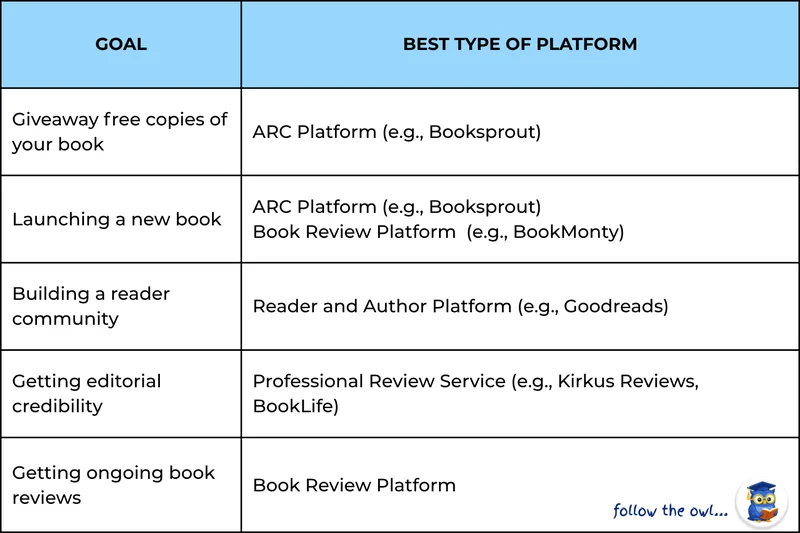
Let's look at each category.
ARC Platforms: Best for Book Launches
ARC stands for Advance Review Copy. And ARC platforms are especially useful for:
- New book launches
- Building early review momentum
- Recruiting launch team members
- Collecting reader feedback prior book launch
One of the best-known examples is Booksprout.
The process is simple:
- Authors upload their book.
- Readers claim a free copy.
- Readers leave an honest review after reading.
If your goal is to get your first reviews before launch day, an ARC platform can be extremely valuable.
However, ARC platforms are usually focused on launch campaigns rather than long-term review growth.
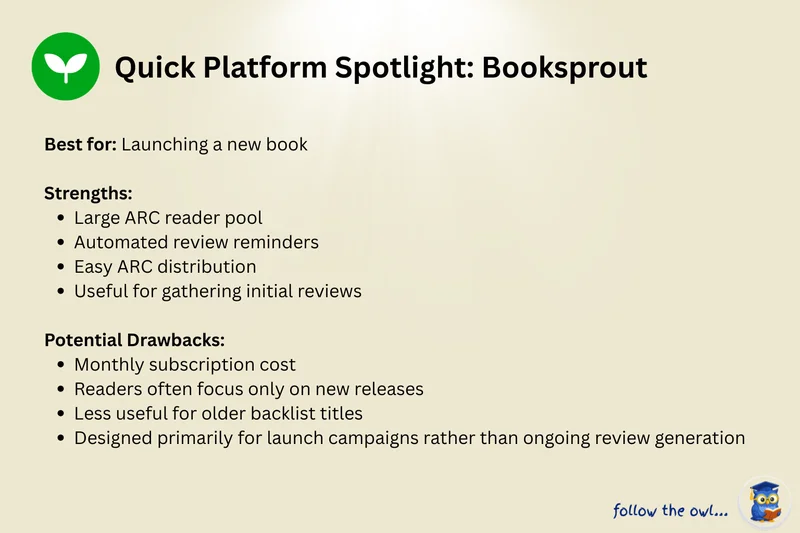
Booksprout alternatives: StoryGraph, LibraryThing, and BookBub
ARC platforms are usually subscription-based. Since they're primarily designed to support book launches, many authors only use them temporarily to gather early reviews before moving on to other marketing strategies.
Reader Communities: Best for Reader Discovery
When people think of book reviews, Goodreads is often the first platform that comes to mind.
But Goodreads is not a review-generation platform. It's primarily a reader community.
Readers use Goodreads to:
- Discover new books
- Track books they've read
- Follow their favorite authors
- Join discussion groups
- Create reading lists
- Rate and review books
Because reviews happen naturally as part of reader activity, Goodreads can be an excellent source of social proof for your books.
How Does Goodreads Work?
Goodreads allows readers to catalog their reading lives while sharing opinions with friends and fellow readers.
For authors, you can:
- Claim an author profile
- Participate in reader discussions
- Run giveaways
- Build visibility
Important: Goodreads does not actively help authors recruit reviewers. Reviews happen organically. So, if you want to use Goodreads to generate reviews, you must put in the time to be part of the community, such as joining Groups, Discussions, and actively participating in them.
Is Goodreads Free to Use?
Yes. Most Goodreads features are completely free for both readers and authors.
Can I Use Goodreads Without an Account?
You can browse many book pages without signing in. However, you'll need an account if you want to:
- Rate books
- Leave reviews
- Join groups
- Create shelves
- Follow authors
For authors, you'll need an account to be able to create your Author Profile and link your books from Amazon (to your Goodreads profile).
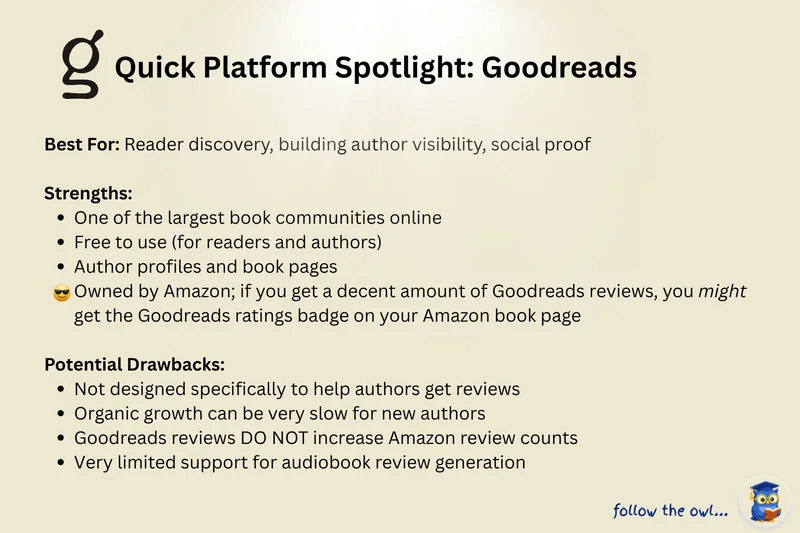
Goodreads alternatives: StoryGraph, LibraryThing, BookBub
Professional Review Services: Best for Industry Validation and Credibility
Professional review services are different from reader-review platforms. Instead of everyday readers, books are reviewed by industry professionals.
Examples include:
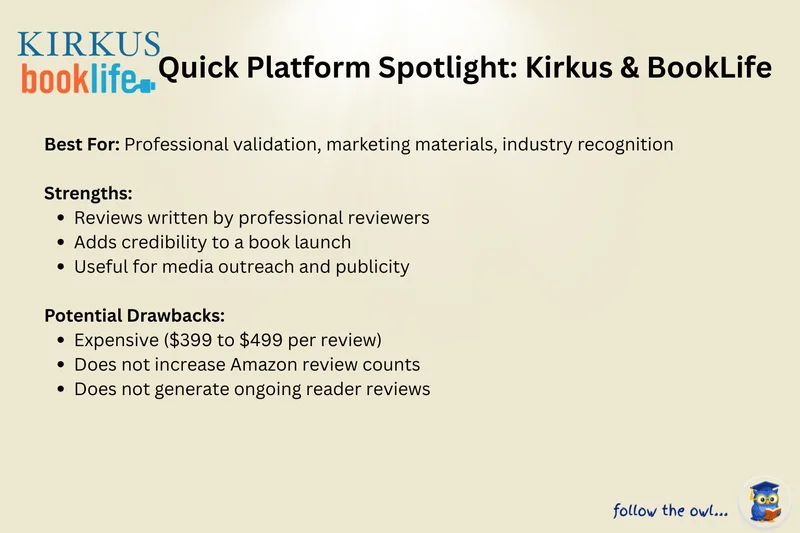
Kirkus Reviews is one of the most respected editorial review services in publishing, while BookLife is a review service operated by Publishers Weekly, another respected name in publishing.
Many authors use positive Kirkus and BookLife reviews in their:
- Book descriptions
- Press releases
- Advertising
- Award submissions
However, neither Kirkus nor BookLife is intended to replace reader reviews.
The main purpose of a review from them is this: professional validation.
Their reviews can strengthen your marketing efforts, but they are not a substitute for genuine reader reviews on Amazon, Goodreads, or review communities.
Review Platforms: Best for Ongoing Reviews
Review platforms focus on helping authors earn reviews consistently over time.
For example, BookMonty was created to help authors build review momentum before and beyond launch day.
Review platforms can be particularly useful for:
- New releases
- Backlist books
- Ongoing review generation
- Audiobook review opportunities (Note: Not all review platforms offer this feature.)
- Consistent visibility
The process is simple:
- Authors add their book or audiobook.
- Reviewers (i.e., other authors or independent readers in the system) discover titles they're interested in.
- Reviewers leave honest reviews after reading or listening.
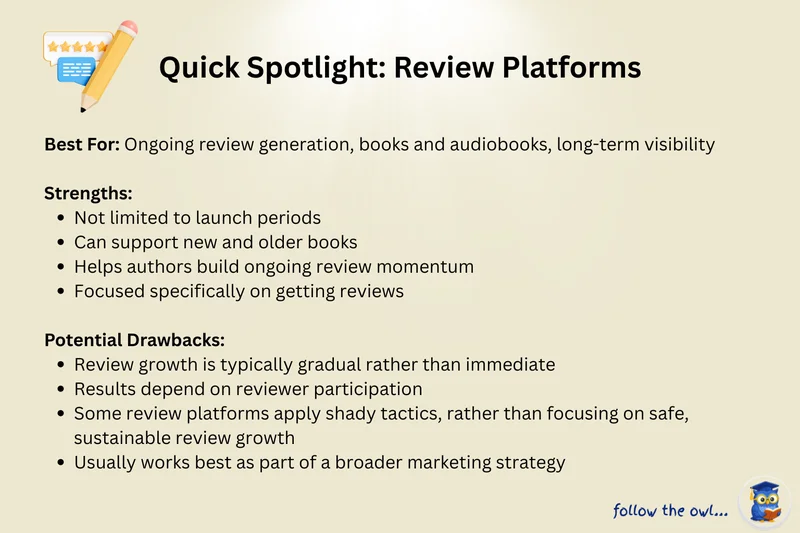
Review platforms are typically subscription-based, making them better suited for authors who are committed to building reviews consistently over time rather than pursuing a short-term launch strategy. The good news is that you can cancel their subscription at any time without affecting any reviews you've already earned.
Frequently Asked Questions
Are Paid Professional Book Reviews Worth It?
This depends on your goals. If your book is being submitted for awards, pitched to media outlets, promoted to libraries, or positioned as a premium nonfiction title, a review from an industry professional may be a worthwhile investment.
However, if your primary goal is to increase book sales, gain social proof, or build a larger number of reader reviews on Amazon or other retail platforms, professional reviews are often less impactful than genuine reader reviews.
Ideally, authors should pursue both. But if your budget is limited, many indie authors will see a greater return from focusing on strategies that generate ongoing reader reviews rather than investing hundreds of dollars in a single editorial review.
Is There a "Rotten Tomatoes" for Books?
Not really. Books don't have a single review aggregator that dominates the market the way Rotten Tomatoes does for movies.
So... Which Book Review Site Is THE Best?
The truth is that there is no single "best" book review site. The best platform depends on your goals.
👉 If you're launching a book, an ARC platform is very useful.
👉 If you're building a long-term reader audience, Goodreads can be valuable.
👉 If you want professional credibility, editorial review services may be worth considering.
👉 If you're looking for ongoing book and audiobook reviews, a reader-review platform may be the better fit.
The Secret Sauce...
Most successful authors DO NOT rely on one platform. Instead, they combine multiple approaches:
- Goodreads for discoverability
- Booksprout for ARC readers before launch
- Review platforms for ongoing growth
This is often the most effective strategy for building long-term visibility and sustainable book sales.
Ready to Start Building More Reviews?
As you've just read, different review platforms solve different problems.
Some are designed for launches. Some focus on reader communities. Others provide professional editorial reviews.
But if your goal is to earn honest book and audiobook reviews consistently over time, you'll need a strategy that goes beyond a single launch or one-time review.
That's exactly why we created BookMonty.
Start Your Free 10-Day Trial and discover how indie authors are using BookMonty to build visibility, credibility, and long-term review growth for both books and audiobooks.