You published your book, sent the link to a few people, and waited. After some time, you check your book page... darn, still no Amazon book reviews.
For a new self-published author, that empty review section can feel like a verdict on the book. Ouch! Usually, though, it says something much simpler: You need a way to put your book in front of readers who are likely to enjoy it, then make it easy for them to share an honest opinion. Those are two separate jobs, and neither happens automatically when you press "Publish."
The short answer: To get Amazon book reviews, find readers who genuinely want your type of book, give them a clear and optional invitation to review, and keep finding new readers after launch. You can use advance reader copies (ARCs), your existing audience, the back of your book, and an ongoing reader community. None of these options mean you should require a review, ask for a particular rating, or trade reviews with another author.
Here’s how to turn that into a workable plan.
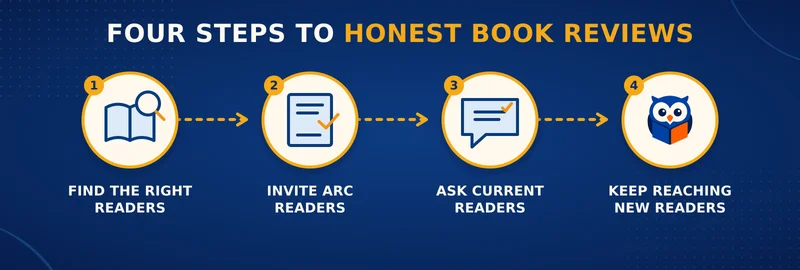
#1 - Start with a book the right readers want to pick up.
A review strategy begins before the request. If your cover signals romance but your book is a business guide, the wrong people may click. If your description doesn’t make the genre, subject, or promise clear, interested readers may pass it by. And if the opening pages don’t deliver what the listing promises, more exposure alone won’t fix the problem.
Look at your cover, description, sample, category, and format through a reader’s eyes. Who would enjoy this book enough to finish it? A reader who chooses your book because it fits their taste is far more useful than a large list of people who downloaded it because it was free. For a journal or workbook, that may mean people who actually use that type of book; for an audiobook, it means listeners who enjoy your genre and narration style.
This is why downloads, ARC claims, and published reviews should be tracked separately. A claim is a sign of interest. A review is a later, independent action by the reader.
Painful truth: Many people who see an ARC invitation won’t claim a copy, and some who do claim one won’t finish or review the book. That makes reader fit more important than raw reach. Put your book in front of people who already enjoy its genre or subject, give them enough time to read, and make your honest-review request easy to find. Then keep reaching new readers after launch instead of expecting one giveaway to deliver all the reviews you need.
#2 - Build an early reader group before launch.
An ARC is a book copy you share before publication, so interested readers can read ahead of release. The hope is that some will post honest reviews soon after your book goes LIVE. That's great because many authors believe that early reviews signal to Amazon that a new book is gaining traction, which in turn may help its visibility. Of course, Amazon doesn't confirm early reviews help boost a book (but it doesn't deny that either 😁). What we can say with confidence is that visible reviews help shoppers decide (social proof!) whether your book is right for them.
You might find those readers through your newsletter, an author community, a genre-specific audience, or an ARC service. Give them an accurate description and enough time to read. And make the invitation clear: an honest review is welcome, but optional.
Do ARC's violate anything on Amazon KDP? No. Amazon’s KDP Customer Reviews guidance says you may provide free or discounted copies of your book, provided you do NOT require a review or try to influence it. It also says that offering anything beyond the free or discounted book, such as a gift card, invalidates the review. Remember: an ARC is an opportunity for a reader to discover your work, not a purchase of their opinion.
You can organize an ARC group before launch, but plan for some readers to be busy, stop reading, or choose not to post. That is normal. When you measure an ARC campaign, distinguish the number of people invited, copies claimed, books finished where known, and reviews that actually appear on your Amazon book page. BookMonty’s BookSprout + BookMonty guide explains how an early ARC campaign + BookMonty book review requests can work together.
#3 - Ask the readers you already have.
If someone has bought and enjoyed your book, don’t just wish they'll leave a review, ASK!
A brief request in the back matter of your book, via your newsletter, or a follow-up to readers who opted in can be enough. Put the invitation near the moment the reader has finished, and make it easy to find the book’s review page.
For example, your back matter could say: If this book was useful to you, would you consider leaving an honest review on Amazon? Your perspective can help another reader decide whether it’s right for them. Thank you for reading.
That wording leaves room for every honest opinion. It doesn’t suggest a star rating, ask readers to contact you before posting, or make a review the condition for receiving something else. And of course, add a direct review link to your book! BookMonty generates one for uploaded books. The link removes unnecessary steps for you, but it doesn't override Amazon’s reviewer eligibility or moderation.
Be thoughtful about whom you ask. Close friends and family may sincerely love your work, yet personal relationships create a conflict of interest under Amazon’s review rules. See BookMonty’s guide to friends and family reviews for a fuller explanation. So, focus your requests on independent readers who chose the book for its content.
#4 - Keep finding new readers after the launch.
An ARC campaign has a deadline; your book’s life does not. A few months after release, you can still mention the book to your newsletter, feature it when a related topic comes up, promote a relevant backlist title, or make it available to a reader community. The useful question is not “How can I collect ten reviews this week?” but “How can suitable readers keep discovering this book?”
BookMonty is built for that ongoing stage. Authors can add a published book or audiobook, earn Hoots through participation in the reader community, and use Hoots for review requests. Its system separates authors and reviewers and blocks direct reciprocal reviews (read: zero review swaps). You can also invite avid readers you know into the Friends & Family Reader Network to review other authors’ books; those readers cannot access your own titles through that feature. This way, you get a structured way to keep a title in circulation, while each reader still decides what to read and review.
You may use an ARC team, your own audience, and an ongoing platform together. Give each channel a clear purpose, and resist treating every claim or reader sign-up as a promised review.
What to Track and What Not to Panic About
Keep a simple record of where readers found the book, how many copies were claimed or purchased, and how many reviews appeared. Over time, this can show whether your main problem is discovery, reader fit, completion, or the last step of asking. A small campaign with readers who love your genre may tell you more than a broad giveaway with many downloads and little reading.
If a reader says they submitted a review and you can’t see it yet, don’t immediately assume anything went wrong. Amazon says its Community team checks reviews against its guidelines, and those checks can take a few days. Amazon may also decline a review, and the author cannot force it through.
Also, don’t make five stars the only acceptable result. A thoughtful three-star review from the right reader may contain useful information for future buyers and for your next book. Honest feedback is the point; you cannot build a durable review strategy by filtering out opinions you dislike.
Common Mistakes that Slow Review Growth
- Asking everyone you know. A supportive relationship doesn’t automatically make someone an independent reviewer. Seek genuine readers outside your close circle.
- Confusing a free download with a guaranteed review. A promotion can introduce a book to many people, but you still need reader fit, time to read, and an optional request.
- Offering extra rewards or asking for a “quick five-star review.” Amazon allows a free or discounted copy under its stated conditions; it does not allow you to require or influence the review. Keep your request neutral.
- Trading reviews with other authors. “I’ll review yours if you review mine” makes the opinions reciprocal rather than independent and conflicts with Amazon’s rules against review manipulation. Build access to readers, not a review swap circle.
- Stopping after launch week. This is one of the biggest mistakes we see. If you have a successful ARC campaign, that's great. But that's still only one stage of the launch process. Give your book a continuous chance to reach readers week after week.
Frequently Asked Questions
How do I get people to review my book on Amazon?
First, help the right people discover and read the book. Then ask once, clearly and without pressure, in places such as your back matter or a reader newsletter. An ARC team or review community can widen your pool of interested readers, but no reader or platform can guarantee a published review.
Can I give readers free copies in exchange for a review?
You can give a free or discounted book to a reader, but Amazon says you cannot require a review in exchange or try to shape what it says. Give the copy upfront and welcome honest feedback, including no review at all. Don’t add gift cards or other compensation. Read Amazon’s current KDP guidance.
Am I allowed to review my own book on Amazon?
No. A review from the author is promotional rather than an independent customer opinion. You can describe your book in its listing and author materials; leave the customer review section to readers. Amazon’s customer review guidance prohibits reviews written as promotion.
Do readers have to buy my book on Amazon to review it?
An Amazon purchase is not required for every review. A reader who received an ARC may be eligible to submit an unverified review, provided they meet Amazon’s account and review rules. A purchase does not guarantee a review will appear, either. Amazon checks submitted reviews against its guidelines. See KDP’s review guidance.
Why is an Amazon book review not showing up?
Amazon says its checks can take a few days. A review may also conflict with its guidelines, be removed by the reviewer, or be attached to an unrelated product. If the reviewer wants to investigate, they should contact the Amazon Community team. See Amazon KDP’s list of common reasons.
The Practical Takeaway
Choose one book. Check that its listing attracts the readers it was written for. Add a short, honest review request to the back. Invite interested ARC or newsletter readers when appropriate, then keep the book visible to new readers after launch. Record claims and published reviews separately. The process will not produce a guaranteed number on a deadline, but it gives each suitable reader a genuine chance to discover, finish, and speak for themselves about your book.