Why Low-Content KDP Books Need Amazon Reviews to Succeed
Low-content KDP books are still booming!
Spend a few minutes on YouTube, and you'll quickly see why nearly every Amazon KDP influencer talks about:
- coloring books
- journals
- planners
- puzzle books
- activity books
The appeal is obvious.
Low-content publishing on Amazon KDP has a much lower barrier to entry than traditional publishing. You don’t need to spend years writing a novel, and tools like Canva and AI image generators make creating books faster than ever.
That’s exactly why thousands of creators are jumping into low-content publishing.
But there’s one thing many beginners underestimate: Publishing low-content KDP books may be easy. Getting those books discovered on Amazon is the hard part.
And that’s where Amazon reviews become incredibly important.
What Is Considered a Low-Content Book on Amazon KDP?
Can You Make Money with KDP Low-Content Books?
Why Most Low-Content KDP Books Never Gain Momentum
Why Amazon Reviews Matter So Much for Low-Content Books
Watch Out: Amazon’s Algorithm Watches Review Activity
The Mistake Many Low-Content Creators Make
What Is Considered a Low-Content Book on Amazon KDP?
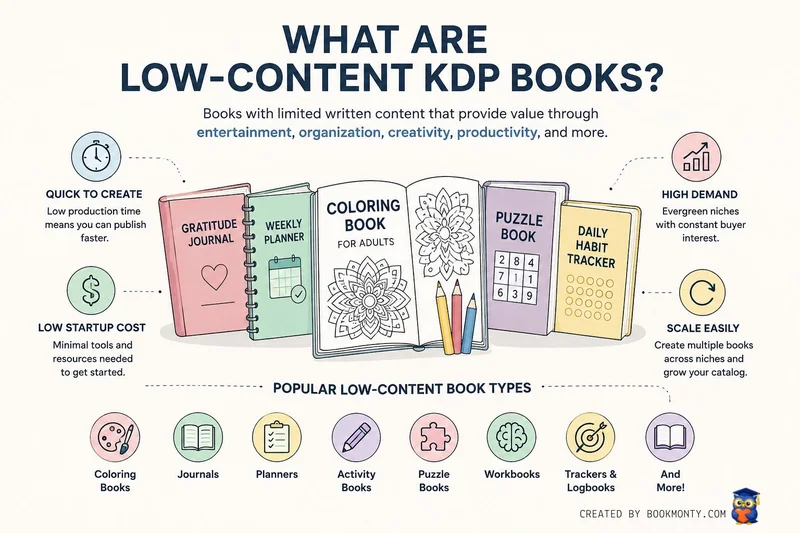
Low-content KDP books are books with limited written content that still provide value through:
- entertainment
- organization
- creativity
- productivity
- relaxation
Popular examples include:
- coloring books
- journals
- planners
- puzzle books
- habit trackers
- activity books
- logbooks
- workbooks
Many creators love low-content publishing because:
- production is faster
- startup costs are lower
- niches are endless
- books can become evergreen assets
Can You Make Money with KDP Low-Content Books?
Yes, but the market is far more competitive than it used to be. A few years ago, creators could upload simple journals or coloring books and still gain traction relatively easily.
Today?
Amazon is flooded with low-content KDP books. Searches for:
coloring book for adults
ADHD planner
gratitude journal
mindfulness workbook
…can return thousands of competing books. That means visibility matters more than ever.
The creators succeeding today usually focus on:
- better branding
- stronger covers
- niche positioning
- launch momentum
- audience building
- review generation
So, it's NOT about uploading more books as fast as you can.
Why Low-Content Books Sell
Some people dismiss low-content KDP books as "simple products." But successful low-content books solve real problems.
Coloring books can reduce stress and encourage creativity. Planners help with organization and productivity. Workbooks help readers take action.
They’re also:
- affordable
- visually appealing
- impulse-friendly
- easy to use
- highly giftable
So, the problem is not demand; the problem is competition.
Why Most Low-Content KDP Books Never Gain Momentum
This is the part many YouTube videos skip: Most low-content KDP books launch to silence.
Not because these books are terrible, but because Amazon has no reason to prioritize them. Think about what Amazon SEES when a new low-content KDP book launches:
- NO purchase history
- NO reviews
- NO engagement
- NO momentum
Now compare that to competing books with:
- hundreds of reviews
- consistent sales
- customer engagement
- conversion history
Which book do you think Amazon is more likely to recommend?
That’s why so many creators upload dozens, sometimes hundreds(!), of low-content books that never gain traction.
Why Amazon Reviews Matter So Much for Low-Content Books
Amazon reviews matter for ALL books. But for low-content KDP books, reviews matter even more because buyers rely heavily on social proof.
With fiction books, readers can evaluate writing style, storytelling pace, characters, etc. With nonfiction, readers can evaluate author expertise, content structure, information quality, and so on.
But with coloring books, journals, and planners? Buyers often depend on:
- reviews
- ratings
- customer photos
- trust signals
- popularity signals
Reviews answer questions like:
“Are the illustrations actually good?”
“Does the paper bleed through?”
“Is this planner useful?”
“Is this worth buying over similar books?”
Without reviews, many buyers simply move on. Think of it this way: there aren't really a lot of things to consider when it comes to low-content books. So, they're more "impulse buys." And what helps move that impulse? Social proof.
Watch Out: Amazon’s Algorithm Watches Review Activity
Amazon is an algorithm-driven marketplace. It constantly tracks clicks, purchases, conversions, engagement, and review activity.
When your low-content KDP book gets reviews, sales, and steady activity, Amazon sees signals of demand. This in turn, can increase:
- visibility
- recommendations
- ranking potential
- “Also Bought” exposure
This is why review velocity matters! Books that gain steady, authentic engagement early often perform better long-term than books with:
- zero reviews for months
- suspicious spikes
- inconsistent activity
The Mistake Many Low-Content Creators Make
Many low-content publishers focus ONLY on:
- creating more books
- trend-chasing
- AI generation
- keyword stuffing
But ignore:
- launch preparation
- ARC readers
- audience building
- review systems
- follow-up strategies
As a result, they publish books, but never build momentum.
Successful low-content publishers understand that publishing is not just uploading files to Amazon. It’s building visibility.
Important: The Goal Is NOT Fake Reviews
When creators realize reviews matter, some make dangerous mistakes:
- buying fake reviews
- doing review swaps
- using fake accounts
- asking friends and family
Amazon increasingly monitors:
- suspicious review behavior
- unnatural activity patterns
- account relationships
So, the goal is not “get as many reviews as possible.” It's to get consistent, authentic, reader-driven reviews. That’s what supports long-term KDP success.
Final Thoughts
Low-content publishing is still one of the biggest opportunities on Amazon KDP.
Coloring books, planners, journals, puzzle books, and workbooks continue to perform extremely well across many niches. But simply uploading them as fast as you can is no longer enough.
Reviews help:
- build trust
- improve visibility
- increase conversions
- create momentum
Especially in crowded low-content niches. But not fake reviews, not manipulated reviews. Real, authentic, consistent reader engagement is the way to go.
That’s what helps low-content KDP books succeed long-term.
FAQ About Low-Content KDP Books
Are low-content KDP books still profitable?
Yes, but competition is much higher. Successful creators focus on branding, niche positioning, visibility, and consistent reviews.
What types of low-content books sell best on Amazon?
Popular categories include:
- coloring books
- planners
- journals
- activity books
- puzzle books
- mindfulness workbooks
- habit trackers
Why do low-content books struggle on Amazon?
Most struggle because they launch with no visibility, no reviews, and no momentum signals for Amazon’s algorithm.
Can low-content books rank without reviews?
They can, but it’s much harder in competitive niches like coloring books, planners, and journals.
What's a good natural review momentum for low-content KDP books?
During launch, many successful low-content KDP creators aim for their first 10–25 authentic reviews to establish trust and momentum. After launch, even a few consistent reviews each month can help maintain visibility.
👉 Want a Practical Next Step?
If you want a simple, compliant way to get your first reviews:
Download the free guide: Get 25+ Amazon Book Reviews—Without Risking Your KDP Account
This guide shows you:
- What works
- What to avoid
- How to build review momentum the right way